
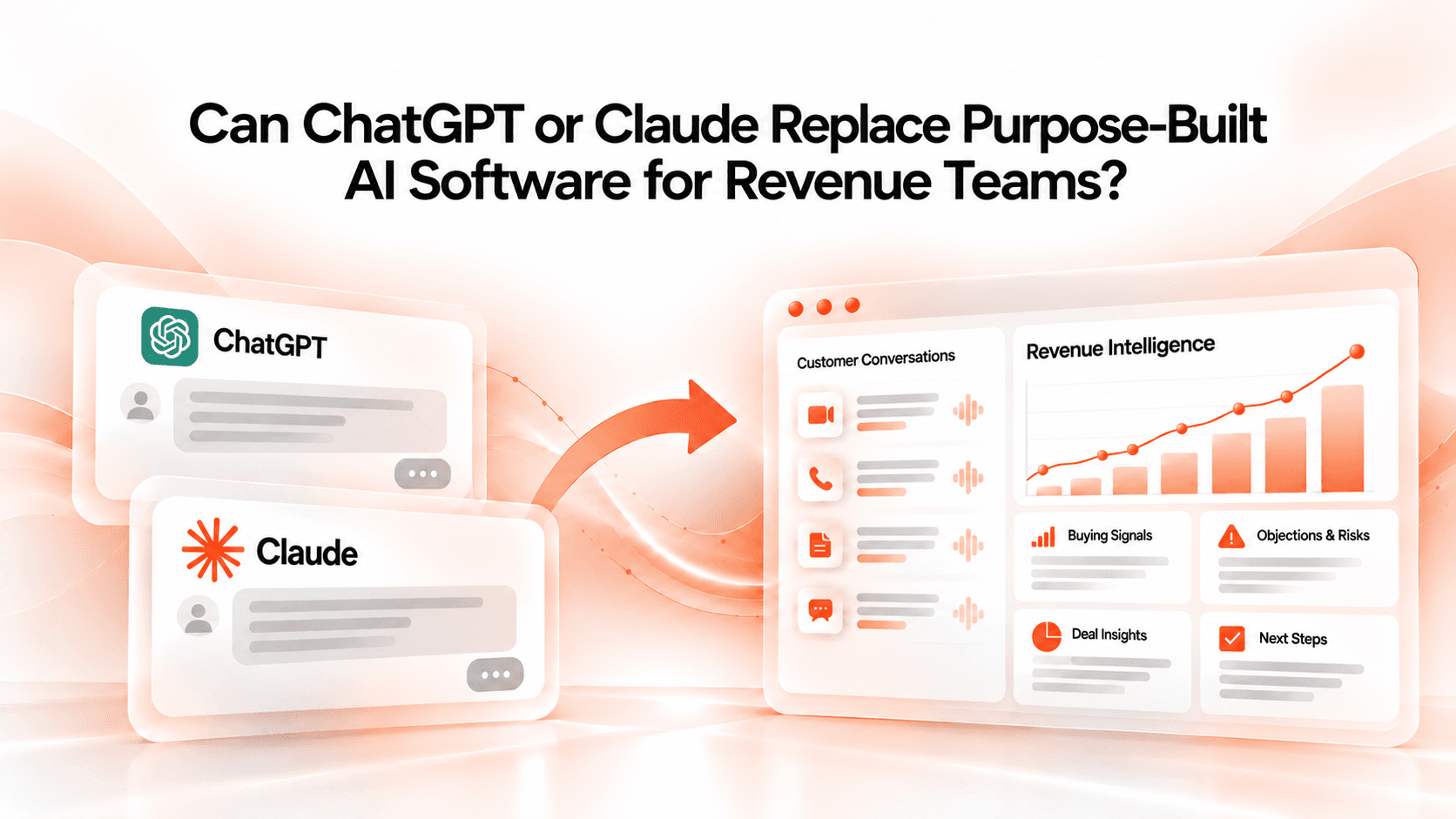
Can ChatGPT or Claude Replace Purpose-Built AI Software for Revenue Teams?
Every revenue team has the same quiet problem. The conversations that decide deals, the discovery calls, demos and negotiations, are full of information about what buyers want, what worries them and how close they are to deciding. Most of it disappears the moment the call ends. Teams try to rescue some of it with notes, memory and, increasingly, ChatGPT or Claude.
Those assistants help. But a general-purpose chat tool answers the question you put in front of it. A revenue team needs something that works on its conversations continuously, applies the same standard to every one of them and connects what it finds to revenue. That's the job HireStar.io's AI Revenue Intelligence System was built for.
The Short Answer
ChatGPT and Claude can replace pieces of the workflow for an individual. They can't replace a system built to turn a team's conversations into revenue decisions. In short:
- •Chat assistants are built to answer questions. A revenue intelligence system is built to improve revenue outcomes.
- •HireStar.io's AI Revenue Intelligence System works from your conversation data, so insight doesn't depend on someone remembering to paste a transcript.
- •It looks across conversations to surface buying signals and patterns, rather than summarizing one call at a time.
- •It applies one framework to every conversation and gives founders, managers and reps a shared view.
- •It works alongside general-purpose AI, not instead of it, and it isn't a lead-generation tool.
What Revenue Teams Actually Need From AI
Ask revenue leaders what they want from AI and the answers are rarely about writing faster. They want to know which deals are really moving and which only sound polite. They want to understand why deals are lost, what buyers keep objecting to and where the forecast is soft. And they want reps and founders to do better in the next conversation, not just to have a tidier summary of the last one.
Those needs share three features. They're about outcomes, not outputs. They're collective, because the answer matters to a whole team and not one person. And they're continuous, because the picture changes with every call.
ChatGPT and Claude are excellent at one-off tasks: a draft, a piece of research, a quick read of a single transcript. Outcomes that are collective and continuous call for a different kind of tool.
Meet HireStar.io's Revenue Intelligence System
HireStar.io is an AI research lab building revenue systems. Its Revenue Intelligence System is organized around one idea: Data → AI → Revenue. Conversation data is the input. AI turns that data into structured understanding, such as what buyers said, what signals they showed and what is likely to matter for the deal. Revenue outcomes are the measure of whether any of it worked.
The design is outcome-first. The goal isn't to produce more notes. It's to help founders and sales teams make better decisions about the opportunities already in their pipeline, and to see more clearly where their revenue is coming from and what is putting it at risk.
Seven Advantages of a Purpose-Built Revenue Intelligence System
Here's where a system built for revenue teams pulls ahead of a general-purpose assistant.
1. Built Around Revenue Outcomes, Not Generic Answers
A general-purpose model is a generalist by design. It can write a poem, debug code and summarize a contract in the same hour. HireStar.io's Revenue Intelligence System is built for one domain: sales conversations and the revenue they produce. Its questions are revenue questions, such as what a buyer is really signalling, where a deal is exposed and what to do next. Teams get analysis framed around outcomes instead of having to engineer the right prompt every time.
2. It Works From Your Conversations, Not Your Copy-Paste
With a chat assistant, insight starts when somebody remembers to export a transcript and write a prompt. In a revenue intelligence system, conversation data is the foundation. Because the input is part of the system rather than an afterthought, the best calls and the busiest weeks get the same treatment, and analysis doesn't depend on individual discipline.
3. Buying Signals and Patterns Across Every Conversation
Summarizing one call is easy. Noticing that a particular objection keeps appearing in late-stage deals, or that a certain kind of buyer behavior tends to come before a decision, takes analysis across many conversations. That's where the Revenue Intelligence System focuses: detecting buying signals and recurring patterns across the pipeline, so leaders see what's happening in aggregate and not just call by call.
4. One Consistent Framework for the Whole Team
Chat-based analysis varies with whoever writes the prompt. The Revenue Intelligence System applies the same framework to every conversation, so a signal means the same thing whether it comes from a founder's demo or a rep's follow-up. That consistency is what makes coaching fair, comparisons meaningful and trends trustworthy.
5. Support During Live Conversations
Most chat-assistant use is retrospective: the call ends, then someone analyzes it. Revenue intelligence is meant to be useful while the conversation is still happening. HireStar.io's system is positioned around real-time guidance for founders and sales reps, including during live demos, because the moment a buyer hesitates is the moment help matters most.
6. Clearer Revenue Visibility for Founders and Leaders
Founders and sales leaders don't just want summaries. They want to know where revenue is heading and what's influencing it. Because the system connects conversation data to revenue outcomes, it gives leaders a clearer basis for judging pipeline health and looking ahead than a folder of individual chat transcripts can.
7. A Shared Record Instead of Private Chats
Calls pasted into personal chat accounts end up scattered across private histories, outside company oversight. A revenue intelligence system keeps conversation insight in one shared place that the team can see, review and build on. That matters for sensitive information such as pricing and contract terms, and it matters for continuity: what the team learns doesn't leave with any one person.
Side by Side: ChatGPT or Claude vs. HireStar.io's Revenue Intelligence System
| Dimension | ChatGPT or Claude | HireStar.io Revenue Intelligence System |
|---|---|---|
| Built for | General-purpose tasks | Revenue teams and sales conversations |
| Starting point | A prompt or pasted transcript | Conversation data as the system's input |
| Scope of analysis | One document at a time | Signals and patterns across conversations |
| Consistency | Varies with prompt and phrasing | One framework applied to every conversation |
| Timing | Mostly after the call | Designed to support live conversations too |
| Visibility | Individual chat histories | A shared view for founders, leaders and reps |
| Measured by | Quality of the answer | Revenue outcomes |
| Best used for | Drafting, research, ad hoc analysis | Ongoing revenue intelligence |
How Each Role Benefits
- •Founders get a clearer read on how buyers respond, support during live demos and a better sense of where revenue is heading, without having to sit in every call.
- •Sales leaders can coach against one standard, spot patterns across the pipeline and base pipeline reviews on what buyers actually said rather than on recollection.
- •Sales reps get guidance in the moment and clearer feedback afterward, instead of generic advice that ignores the deal in front of them.
From Conversations to Revenue: How Data → AI → Revenue Works in Practice
The framework behind HireStar.io's Revenue Intelligence System is easiest to understand as three connected steps.
- 1Data. Everything starts with the conversations that happen across your sales process: discovery calls, demos, follow-ups and negotiations. Instead of living in memory and scattered notes, they become the raw material the system works from.
- 2AI. The system turns that raw material into structured understanding. It picks out what buyers asked, which objections came up, what buying signals appeared and where a deal looks exposed, and it does so against the same framework every time.
- 3Revenue. The final step is the one chat tools usually leave to the user. Findings are tied to decisions: which deals deserve attention this week, what a rep should change in the next call, where a founder should look more closely and how healthy the pipeline really is.
Each step feeds the next, and the loop keeps running as new conversations come in. That's what separates a system from a one-off analysis. The picture gets sharper with every call, and the whole team works from it.
Key Features of HireStar.io's Revenue Intelligence System
Here's what the system is designed to give revenue teams:
- •Conversation intelligence: Turns sales conversations into structured understanding: what buyers asked, which objections came up and what was agreed.
- •Buying signal detection: Identifies the signals that show a buyer's interest, hesitation or readiness, across calls rather than one at a time.
- •Live guidance for demos and calls: Supports founders and reps in the moment, while the conversation is still unfolding.
- •A consistent evaluation framework: Applies the same criteria to every conversation, so coaching and comparisons are fair.
- •Revenue visibility: Connects conversation findings to pipeline health and the direction of revenue, so leaders can see where to focus.
- •A shared team view: Gives founders, sales leaders and reps one place to see what their conversations are telling them.
Each feature serves the same outcome: helping teams make better decisions about the opportunities already in their pipeline. Together, they're what make the Revenue Intelligence System a system rather than a prompt.
Frequently Asked Questions
- •Can ChatGPT or Claude replace a revenue intelligence system? For individuals and small, one-off tasks, they can cover a lot. For a team that needs shared conversation data, consistent evaluation and a view tied to revenue, they can't. The gap is about data, continuity and workflow rather than model intelligence.
- •Why is a revenue intelligence system better suited to revenue teams? Because it's built for the job. It starts from conversation data, applies one framework across the team, looks for patterns across conversations and keeps a shared record. A chat assistant is built to be good at almost everything, which is a strength elsewhere but a limitation here.
- •Why should revenue teams use an AI revenue intelligence system instead of ChatGPT or Claude? Because it's built for the job. It starts from conversation data rather than pasted transcripts, applies one evaluation framework to every call, looks for buying signals and patterns across conversations and gives the whole team a shared view. A general-purpose assistant is designed to be good at almost everything, which is a strength elsewhere but a limitation for ongoing, team-wide revenue analysis.
- •How does HireStar.io's AI revenue intelligence help during live demos and sales calls? The system is designed to support founders and sales reps in the moment, including during live demos, not only after the call has ended. The aim is to help at the point where a buyer hesitates or a question goes unanswered, when guidance matters most.
- •What can it show leaders that individual call summaries can't? Patterns and direction. Across conversations, the system helps leaders see which objections keep recurring, which buying signals appear as deals move forward and where the pipeline is exposed, so they can decide where to focus coaching and attention. A summary of a single call can't show that.
Conclusion
ChatGPT and Claude have changed what one person can get done in a day, but a revenue team's real questions are about patterns, timing and outcomes, and those need more than a chat window. They need a system that starts from your conversations, treats every one of them the same way and ties what it finds to revenue.
That's the case for HireStar.io's AI Revenue Intelligence System. It gives founders, sales leaders and reps a shared, consistent view of what's happening in their conversations, and helps them act on it. Chat assistants help you work faster. A revenue intelligence system helps you see what's driving revenue.
See how HireStar.io's Revenue Intelligence System helps revenue teams turn conversations into revenue decisions. Explore the Revenue Intelligence System