
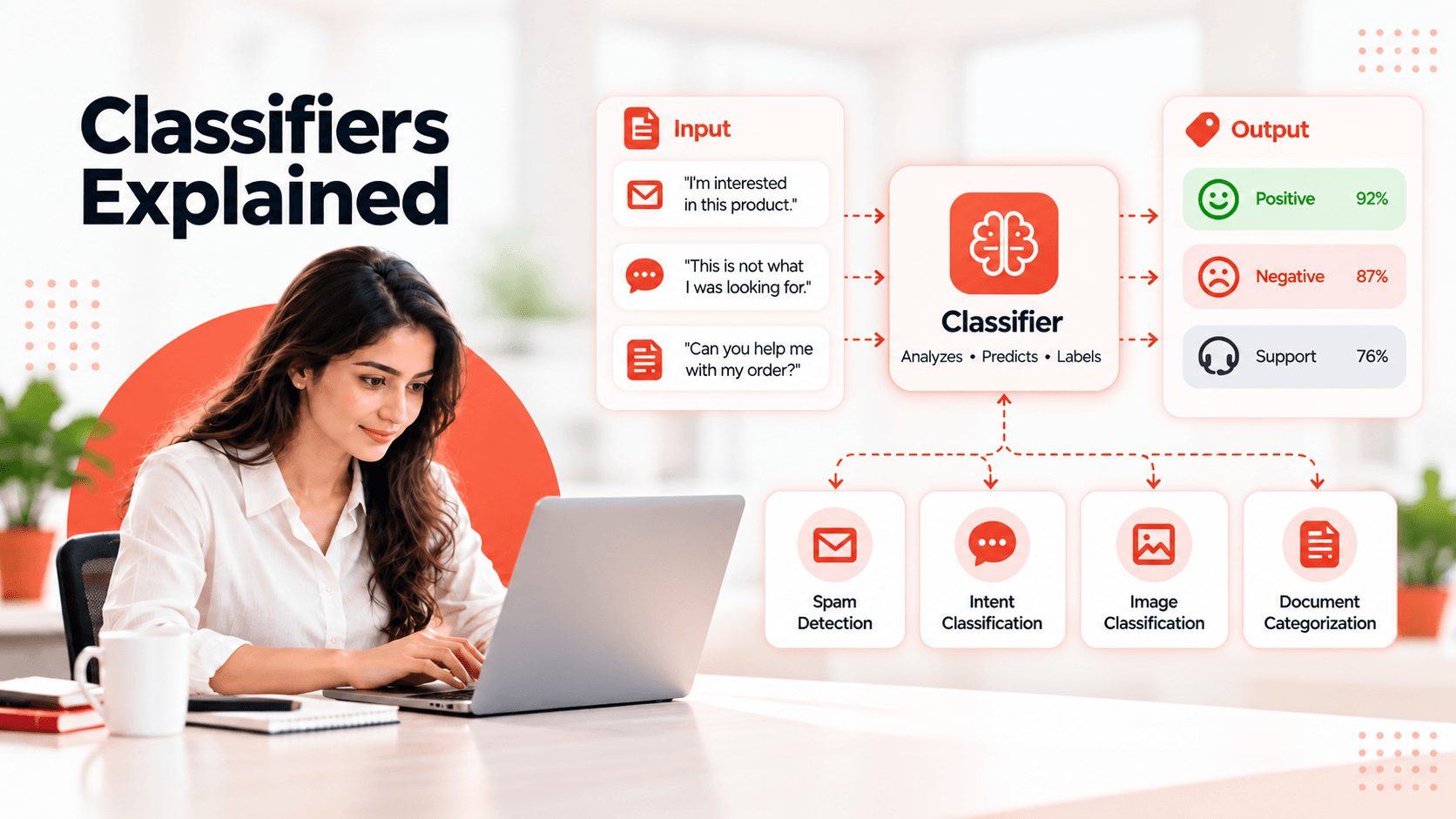
Classifiers Explained: The Quiet Workhorse Behind Everyday AI
Every time your inbox catches a spam email, your bank flags a suspicious transaction, or a support ticket lands with the right team automatically, there is a good chance a classifier made that decision.
Classifiers are among the oldest and most widely used tools in machine learning. They don't get as much attention as chatbots or image generators, but they power a huge share of the AI that businesses depend on every day. In this post, we'll explain what classifiers are, how they learn, how to tell whether one is actually working, and what it takes to build one that holds up in the real world. They also matter to revenue and voice products like HireStar.io Revenue Intelligence System and Voice AI, where decisions about intent, priority, and routing happen constantly.
What Is a Classifier?
A classifier is a model that looks at an input and assigns it to one of a set of categories, called classes or labels.
- •Is this email spam or not spam?
- •Is this review positive, negative, or neutral?
- •Which department should this support ticket go to: billing, technical, or sales?
- •Does this X-ray show signs of a particular condition?
The input can be almost anything: text, images, audio, numbers in a spreadsheet, or a combination. The output is a decision, usually along with a confidence score that tells you how sure the model is.
Types of Classification
Not all classification problems look the same. There are three common setups.
- •Binary classification has exactly two possible outcomes. Fraud or not fraud. Churn or stay. Pass or fail. It's the simplest and most common form.
- •Multi-class classification has more than two options, but each input belongs to exactly one. A news article might be classified as sports, politics, business, or technology, but only one of them.
- •Multi-label classification allows an input to belong to several classes at once. A single customer message could be about billing and a delivery delay and be urgent, all at the same time.
Knowing which type you're dealing with early on shapes how you collect data, choose a model, and measure success.
How Classifiers Learn
Most classifiers are trained using supervised learning. The idea is straightforward:
- 1Collect labeled examples. You gather inputs where you already know the correct answer, such as thousands of emails that humans have marked as spam or not spam.
- 2Train the model. The model looks at these examples and adjusts its internal parameters to find patterns that separate one class from another.
- 3Evaluate on unseen data. You test the model on examples it has never seen to check whether it has truly learned general patterns or has simply memorized the training set.
- 4Deploy and monitor. Once it performs well, the model starts making predictions on real data, and you keep an eye on how it behaves over time.
The quality of your labeled data matters more than almost anything else. A sophisticated model trained on inconsistent or biased labels will confidently learn the wrong lessons.
Common Classification Algorithms
There is no single "best" classifier. The right choice depends on your data, your accuracy needs, and how much you need to explain the model's decisions.
| Algorithm | Best for | Why teams use it |
|---|---|---|
| Logistic regression | Baselines, regulated industries | Despite the name, it's a classification method — fast, simple, and easy to interpret. |
| Decision trees | Explainable rules | Split data with a series of yes-or-no questions, like a flowchart. Intuitive, but can overfit on their own. |
| Random forests & gradient-boosted trees | Structured / tabular data | Combine many trees into one stronger model. Often top performers on customer records or transaction logs. |
| Support vector machines (SVMs) | Smaller datasets, text | Find the boundary that best separates classes. A go-to for text classification for many years. |
| Neural networks | Images, audio, free-form text | Deep models usually lead on unstructured data. Transformer-based models are now standard for many text tasks. |
A good rule of thumb: start with the simplest model that could work, measure it honestly, and only add complexity when the results justify it.
Measuring Performance: Why Accuracy Isn't Enough
Imagine you build a fraud detection model and it reports 99% accuracy. Sounds great. But if only 1% of transactions are fraudulent, a model that simply labels everything as "not fraud" would also be 99% accurate, while catching zero fraud.
This is why teams look beyond accuracy.
The confusion matrix
A confusion matrix breaks predictions into four buckets:
| Model says: Fraud | Model says: Not fraud | |
|---|---|---|
| Actually fraud | True positive — fraud correctly flagged | False negative — fraud that slipped through |
| Actually legitimate | False positive — legitimate transaction wrongly flagged | True negative — legitimate transaction correctly left alone |
Precision and recall
- •Precision answers: Of everything the model flagged, how much was actually correct? High precision means few false alarms.
- •Recall answers: Of all the real cases, how many did the model catch? High recall means few misses.
There is usually a trade-off between the two. A spam filter with very high recall may catch every spam email but also bury important messages in the junk folder. A medical screening tool, on the other hand, may favor recall because missing a real case is far more costly than a follow-up test.
F1 score and thresholds
The F1 score combines precision and recall into a single number, which is useful for comparing models. And because most classifiers output a probability, you can adjust the decision threshold to shift the balance. Lowering the threshold catches more cases at the cost of more false alarms; raising it does the opposite. Choosing the threshold is a business decision as much as a technical one.
Where Businesses Use Classifiers
Classifiers show up in nearly every industry:
- •Customer support: routing tickets, detecting urgency, and identifying intent in chat and email.
- •Finance: fraud detection, credit risk assessment, and flagging unusual activity. Verification-focused systems such as HireStar.io BGV AI face a related challenge: separating genuine records from suspicious ones.
- •E-commerce: product categorization, review sentiment analysis, and detecting fake listings.
- •Content moderation: identifying spam, abuse, or policy-violating content at scale.
- •Healthcare: assisting clinicians by flagging scans or records that may need closer review.
- •Sales and marketing: lead scoring and predicting which customers are likely to churn. This is the kind of decision layer that supports revenue systems like HireStar.io Revenue Intelligence System.
- •Voice and speech applications: classifying audio for language identification, speaker type, or intent before it's passed to the next system. HireStar.io Voice AI works in this space, where fast, accurate decisions about audio and intent keep AI calls natural.
In many of these cases, the classifier doesn't replace human judgment. It helps people focus their attention where it matters most.
Pitfalls to Watch Out For
Building a classifier that performs well in a notebook is one thing. Building one that performs well in production is another. Here are the issues that trip teams up most often.
- •Class imbalance. When one class is rare, as with fraud or defects, models tend to ignore it. Techniques such as resampling, class weighting, and choosing the right metrics help.
- •Data leakage. If information about the answer sneaks into the training features, the model will look brilliant during testing and fail in the real world. A classic example is including a "refund issued" field when predicting whether a customer will complain.
- •Data drift. The world changes. Customer behavior shifts, new products launch, fraudsters adapt. A model trained on last year's data can quietly lose accuracy. Ongoing monitoring and periodic retraining are essential.
- •Bias and fairness. If historical data reflects unfair decisions, a classifier can learn and amplify them. It's important to evaluate performance across different user groups and to question what the labels really represent.
- •Overconfidence. A model can be confidently wrong, especially on inputs unlike anything it saw in training. Well-calibrated confidence scores and a path to human review for uncertain cases make systems much safer.
Classifiers in the Age of Large Language Models
With powerful large language models (LLMs) now widely available, a fair question is: Do we still need dedicated classifiers?
In many cases, yes. LLMs are excellent for quickly prototyping a classification task using just a prompt and a few examples, and they handle nuanced or messy text well. But purpose-built classifiers are often faster, cheaper to run at high volume, easier to evaluate consistently, and simpler to deploy in environments with strict latency or privacy requirements.
A practical pattern many teams use is to combine both: use an LLM to help label data or handle rare, complex cases, and use a lightweight trained classifier for the high-volume, everyday decisions. That hybrid thinking is relevant to how HireStar.io designs Voice AI and the Revenue Intelligence System: large models for nuance, lighter models for speed.
Building a Classifier: A Simple Roadmap
If you're starting a classification project, this sequence keeps things on track:
- 1Define the decision clearly. What exactly are you classifying, and what action follows each outcome?
- 2Decide what "good" means. Pick metrics that reflect real business costs, such as missed fraud versus annoyed customers.
- 3Gather and label quality data. Write clear labeling guidelines and check for agreement between labelers.
- 4Start with a baseline. A simple model gives you a benchmark to beat.
- 5Iterate thoughtfully. Improve features, try stronger models, and tune thresholds.
- 6Test on realistic data. Include edge cases, recent data, and underrepresented groups.
- 7Deploy with monitoring. Track performance, drift, and feedback, and plan for retraining. This feedback loop is also how HireStar.io Voice AI improves over time.
Final Thoughts
Classifiers may not be the flashiest part of AI, but they are some of the most dependable. They sort, route, flag, and prioritize at a scale no team could manage by hand, freeing people to focus on the decisions that truly need human insight.
The best classifiers aren't just accurate. They are built on good data, measured with the right metrics, monitored after launch, and designed with fairness and real-world consequences in mind. HireStar.io applies this mindset across its Voice AI, Revenue Intelligence System, and BGV AI products.
FAQs – Classifiers Explained
- •What is a classifier in machine learning? A classifier is a model that assigns an input, such as text, an image, or audio, to one of a set of categories, usually with a confidence score.
- •What is the difference between binary, multi-class, and multi-label classification? Binary has two outcomes, multi-class has several but only one applies, and multi-label lets one input belong to multiple classes at once.
- •Why isn't accuracy enough to judge a classifier? With rare classes like fraud, a model that predicts the majority class every time can score 99% accuracy while catching nothing. Precision, recall, and F1 give a truer picture.
- •What is the difference between precision and recall? Precision measures how many flagged cases were correct, while recall measures how many real cases were caught. Raising one often lowers the other, so thresholds should reflect business cost.
- •Do we still need classifiers now that LLMs exist? Often yes. LLMs are great for prototyping and messy text, but trained classifiers are usually faster, cheaper at volume, and easier to evaluate and deploy under strict latency or privacy needs.
- •Where do classification-style decisions appear in HireStar.io's products? Decisions about intent, priority, routing, and verification matter across HireStar.io Revenue Intelligence System, Voice AI, and BGV AI.
Thinking about adding smart classification to your workflows? Reach out to the HireStar.io team — we'd be happy to help you find the right approach. Talk to our team