
What Are the Most Common Background Verification Red Flags?
Every HR team eventually finds one: a résumé that looks perfect until you dig into the details. Spotting these warning signs early is the entire point of background verification — and it's exactly the kind of work HireStar.io is built to handle. Below are the red flags that show up most often in Indian hiring, and what they usually mean for HR teams trying to hire fast without hiring wrong.
What Is a Background Verification Red Flag?
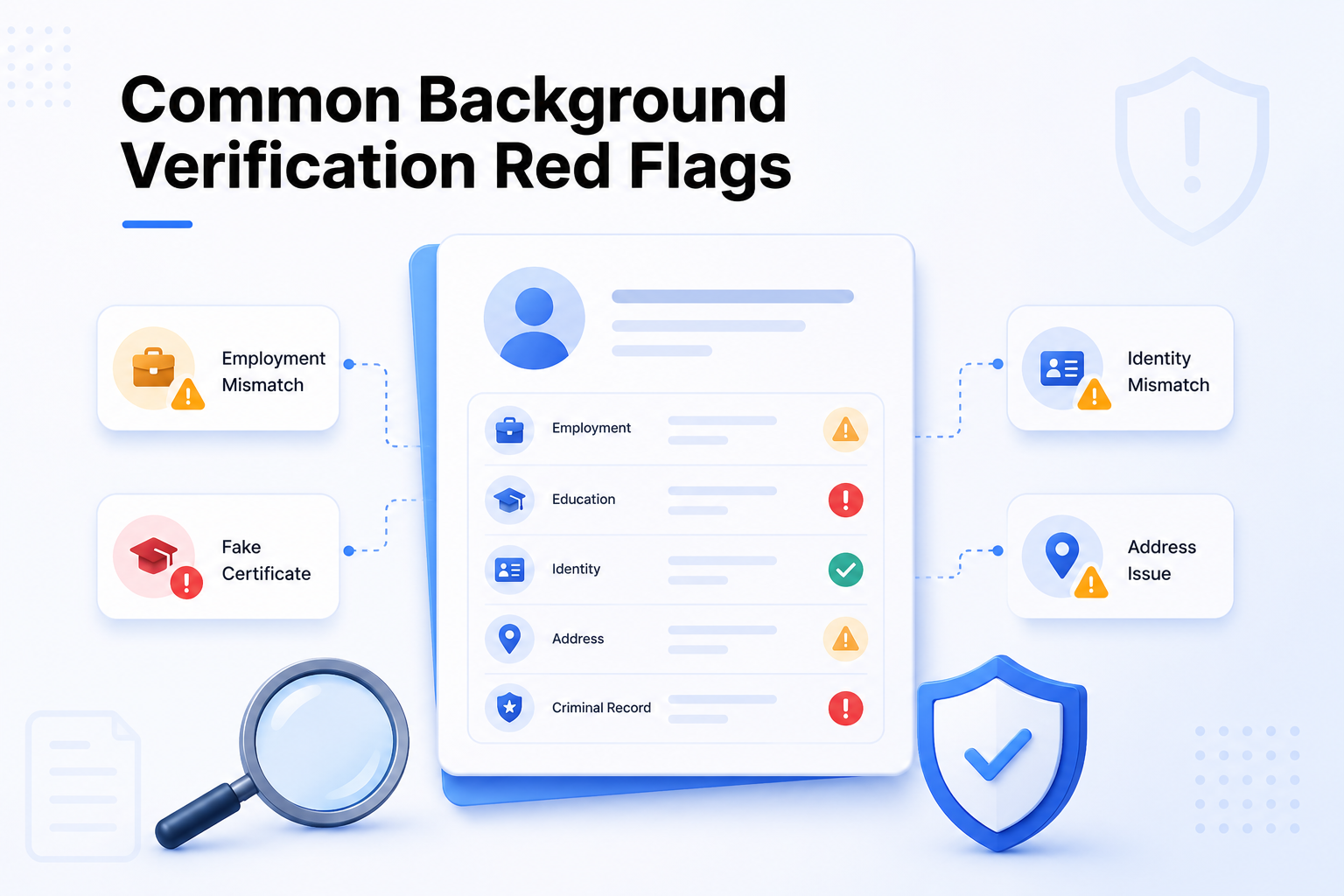
A red flag is any mismatch between what a candidate claims and what official records actually show — an employment date that doesn't line up, a degree from a college that has no record of them, or an address that traces back to nowhere. Not every red flag means fraud; some are honest mistakes. But every red flag deserves a closer look before an offer letter goes out. HireStar.io builds this closer look directly into its screening workflow, flagging discrepancies the moment they surface instead of after onboarding is already underway.
How Does HireStar.io Catch Background Verification Red Flags?
- 1. Candidate Consent – Verification begins only after the candidate signs a DPDP Act 2023-compliant consent form.
- 2. Document Upload – Aadhaar, PAN, degree certificates, and employment letters are submitted through a secure portal.
- 3. AI Document Screening – Machine learning models scan every document for tampering, font mismatches, and altered seals or signatures.
- 4. Primary Source Verification – Details are cross-checked directly with universities, past employers, and government databases.
- 5. Blockchain Logging – Every verified result is written to an immutable ledger, so the audit trail can never be quietly edited later.
- 6. Flagged Report Delivery – HR receives a color-coded report highlighting exactly which claims passed, failed, or need follow-up.
The result is a review process HR teams can trust — fast enough for high-volume hiring, thorough enough to catch the details a manual check would miss.
Most Common Background Verification Red Flags
Employment History Mismatches
This is the single biggest category of discrepancy in Indian hiring. Job titles get inflated, tenure gets stretched to cover a gap, and in more serious cases, candidates list employment at companies that no longer exist — or never did. Employment verification through background verification services contacts past employers directly, which is the only reliable way to catch a fabricated role before it becomes a payroll problem.
Fake or Unaccredited Educational Credentials
Diploma mills are a growing problem across India, often using names that closely mimic real universities. A candidate may present a certificate that looks entirely legitimate on paper — which is exactly why a 'fake certificate detection tool' matters. HireStar.io's AI models are trained to catch subtle signs of forgery — mismatched fonts, altered seals, inconsistent formatting — that a manual reviewer skimming a PDF could easily miss.
Undisclosed Criminal Records
Failing to disclose a past criminal case, even one that ended in acquittal, is one of the more sensitive red flags to handle. Court and police record checks surface these cases, but context matters — HR teams need to weigh relevance to the role rather than issuing an automatic rejection.
Address and Identity Inconsistencies
An address that doesn't match utility records, or an Aadhaar number that fails validation, is often the first sign something else in the application won't hold up either. Identity checks anchor every other verification step, which is why they run first in most screening workflows.
Frequent, Unexplained Job Hopping
Short stints at multiple companies aren't automatically disqualifying — contract work, layoffs, and relocation all explain legitimate gaps. But a pattern with no reasonable explanation is worth a direct conversation before an offer is finalized.
Benefits of AI Powered Background Verification for Catching Red Flags
Faster Discrepancy Detection
AI powered background verification flags anomalies within hours instead of days, so HR teams aren't left waiting on a manual review to catch an obvious forgery.
Fewer Human Errors
A reviewer checking hundreds of documents a week will eventually miss something. AI models don't get tired, and they apply the same scrutiny to document one and document one thousand.
Tamper-Proof Records
Blockchain powered background verification locks every verified result into an immutable ledger. Once a discrepancy is logged, it can't be quietly altered — a critical safeguard for compliance audits.
Lower Risk of Repeat Offenders
Portable, blockchain-backed credentials mean a candidate flagged for fraud at one company can't simply reapply elsewhere with a cleaner-looking file.
Key Red-Flag Detection Services Offered by HireStar.io
Fake Certificate Detection
HireStar.io's 'fake certificate detection tool' scans uploaded degrees and diplomas for forgery indicators before they ever reach a human reviewer.
Employment Authenticity Checks
Direct outreach to past employers confirms job titles, dates, and whether the company itself is real.
Criminal Record Screening
Court and police database checks surface undisclosed cases relevant to the role in question.
Identity and Address Verification
Aadhaar and PAN validation, cross-checked against government databases, confirms a candidate is exactly who they claim to be.
Continuous Monitoring
For sensitive roles, periodic re-checks catch new red flags that surface after the initial hire.
Why HireStar.io Stands Out for Red-Flag Detection in India
AI-First Fraud Detection
HireStar.io was built around AI powered background verification from day one, not retrofitted onto a manual process.
Immutable Compliance Trail
Blockchain powered background verification means every flag raised is permanently recorded and auditable.
DPDP Act 2023 Alignment
Consent and data-handling workflows are built around India's current data protection law from the ground up.
Built for High-Volume Hiring
Whether screening 20 candidates a month or 2,000, red-flag detection scales without slowing down turnaround time.
FAQs – Background Verification Red Flags
- Does one red flag automatically disqualify a candidate? No. Minor discrepancies, like a job title listed slightly differently than official records show, are usually flagged for clarification rather than automatic rejection. Serious fraud, like a fabricated employer or fake degree, is treated differently.
- How does a fake certificate detection tool actually spot forged documents? It scans for inconsistencies humans often miss — mismatched fonts, altered seals, irregular formatting — and flags anything that doesn't match known patterns from the issuing institution.
- Is AI powered background verification more accurate than manual review? It's more consistent. AI doesn't get fatigued reviewing document 500 of the day, so it catches subtle red flags a tired reviewer might scroll past.
- Why does blockchain matter for red-flag detection? Once a verification result is logged on a blockchain, it can't be quietly edited or deleted — which matters enormously during compliance audits and legal disputes.
- What should HR do when a background verification service flags a candidate? Review the specific discrepancy, give the candidate a chance to explain, and weigh the relevance of the issue to the role before making a final call.
Conclusion: Catch Red Flags Before They Become Bad Hires
Resume fraud isn't rare — it's routine, and the red flags above show up in hiring pipelines across every industry in India. HireStar.io's AI and blockchain-powered platform gives HR teams the speed and accuracy to catch these warning signs before an offer letter goes out. The outcome is a hiring process built on verified trust, not assumptions.