
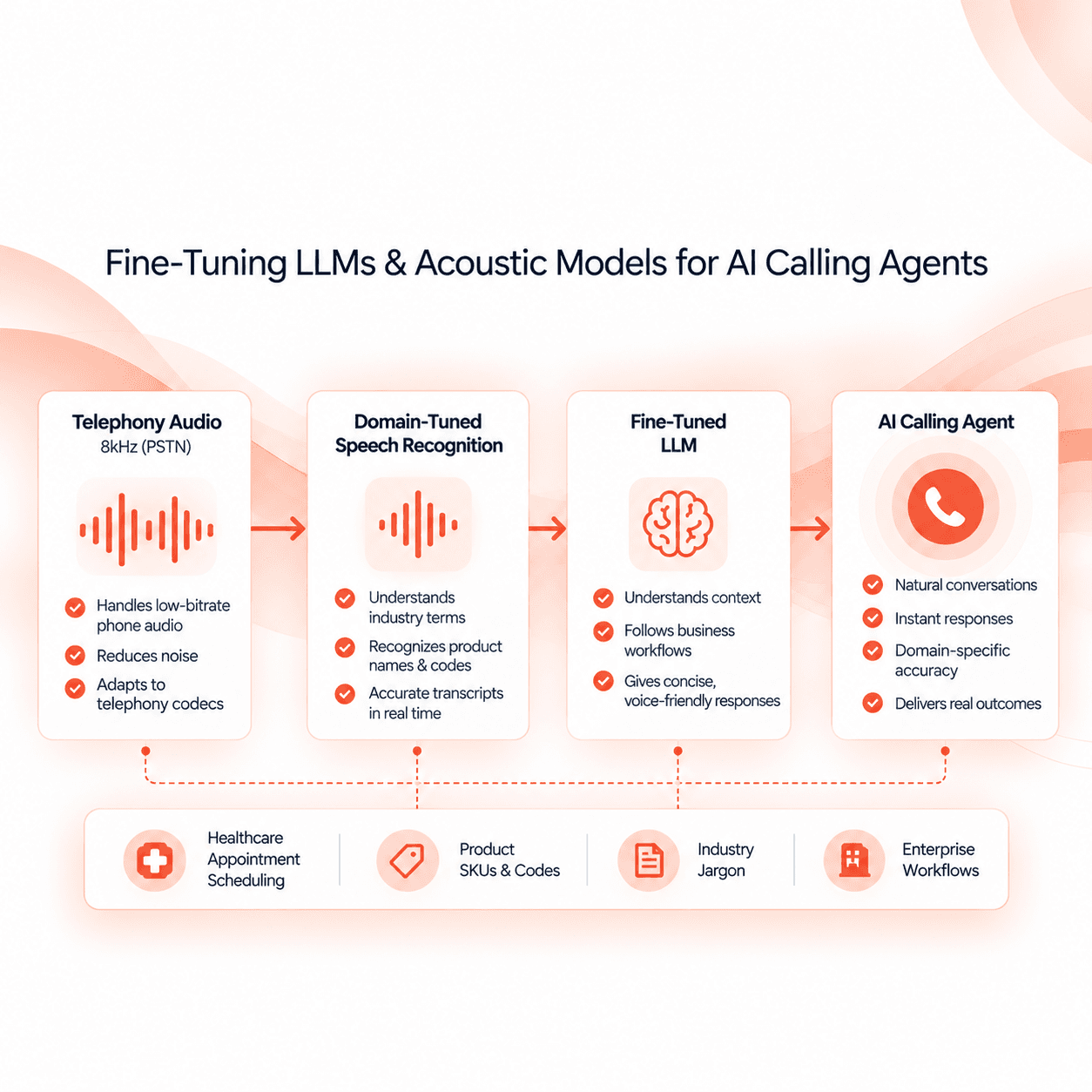
The Telephony Problem: Why General-Purpose Models Falter
AI calling agents need to understand spoken language, respond naturally, and complete tasks while a conversation is happening. Unlike text-based AI applications, voice systems must also handle noisy audio, accents, interruptions, pauses, and the constraints of telephone communication.
A general-purpose language model may generate fluent responses, but fluency alone does not guarantee a reliable voice conversation. The speech recognition system must correctly interpret what the caller says, while the language model must understand the intent and respond appropriately.
Telephone audio often has lower bandwidth than studio-quality recordings. Background noise, overlapping speech, unfamiliar names, product terminology, and regional pronunciation can further reduce recognition accuracy. These challenges can lead to incorrect transcripts and misunderstandings.
Latency is another important constraint. A voice agent that waits too long before responding can make a conversation feel unnatural. An effective system must balance recognition accuracy, response quality, processing time, and the cost of running its models.
Fine-tuning helps address these challenges by adapting model behavior to the actual data, vocabulary, conversation patterns, and tasks encountered by a calling application. The best approach depends on which part of the voice pipeline is causing the problem.
The Dual-Layer Fine-Tuning Strategy
A practical voice AI architecture can be improved at two distinct layers: the acoustic and speech-recognition layer, and the language-model layer. Each layer solves a different problem, so treating them separately makes it easier to identify performance gaps and measure improvements.
The first layer focuses on converting incoming audio into accurate text. The second layer focuses on understanding that text, managing the conversation, and generating an appropriate response.
- •Layer 1 — Acoustic model and speech decoder adaptation: improve how the system recognizes speech, accents, terminology, and telephone audio.
- •Layer 2 — LLM fine-tuning: improve intent understanding, dialogue behavior, response structure, and task-specific decisions.
These layers interact. An inaccurate transcript can cause a language model to make the wrong decision, even if the language model itself is highly capable. Similarly, an accurate transcript does not guarantee a useful response if the model misunderstands the caller's goal.
For this reason, evaluate the entire pipeline as well as each individual component. Improving one layer should not be assumed to improve every end-to-end metric automatically.
Layer 1: Acoustic Model & Speech Decoder Domain Adaptation
The acoustic layer processes incoming speech and helps the system identify the words being spoken. Depending on the architecture, this process may involve acoustic representations, an acoustic model, a speech recognition model, and decoding components that produce the final transcript.
Domain adaptation makes the speech pipeline better suited to the environment in which the calling agent operates. For example, a customer support agent may need to recognize company names, product codes, regional place names, industry terminology, and frequently used abbreviations.
Collect representative audio data
Start by collecting audio samples that reflect real calling conditions. Include different speakers, accents, speaking speeds, microphone qualities, background noise levels, and conversational situations. Each audio sample should have a carefully reviewed transcript when it is used as supervised training data.
Data quality matters. Incorrect transcripts can teach a model the wrong associations, while a dataset that does not represent real callers may produce improvements that fail to transfer to production.
Adapt vocabulary and decoding behavior
Specialized vocabulary can be difficult for general-purpose speech recognition systems. Depending on the speech engine, vocabulary hints, phrase boosting, custom dictionaries, language-model adaptation, or supervised fine-tuning may help improve recognition of domain-specific terms.
The available techniques depend on the speech recognition model and whether its components can be customized. Some hosted speech APIs provide vocabulary configuration without allowing access to model weights.
Measure speech recognition accuracy
Word Error Rate (WER) is a common metric for evaluating speech recognition. It measures substitutions, deletions, and insertions relative to a reference transcript. Character Error Rate can also be useful for some languages and transcription tasks.
Do not rely on a single aggregate score. Evaluate difficult names, important numbers, domain-specific terms, accents, noisy recordings, and real telephone audio separately. A small overall improvement may hide a significant regression in a business-critical category.
Layer 2: LLM Fine-Tuning for Real-Time Conversational Voice
After speech has been transcribed, the language model must interpret the caller's intent and decide what to say or do next. In an AI calling agent, this can include asking follow-up questions, collecting required information, checking eligibility, retrieving information, or completing a workflow.
LLM fine-tuning adapts a model using examples that demonstrate the desired behavior. Rather than relying exclusively on instructions supplied at inference time, a tuned model can learn recurring patterns in the tasks and conversation styles represented by its training data.
Build a task-specific conversation dataset
Training examples should reflect realistic caller requests and the responses expected from the agent. Include straightforward requests, ambiguous questions, corrections, interruptions, incomplete answers, unsupported requests, and cases where the agent must ask for clarification.
For structured workflows, examples should show how the model extracts relevant information, identifies missing fields, and follows the required sequence of actions. If the system uses tools or APIs, the training and evaluation data should reflect the expected tool-calling format.
Improve response length and conversational behavior
Voice conversations have different requirements from written conversations. Long paragraphs are difficult to listen to, and overly complicated answers can make a calling agent sound unnatural. A voice-focused model should produce clear, concise responses and ask one useful question at a time when the workflow requires it.
- •Keep spoken responses concise and easy to understand.
- •Ask relevant follow-up questions when information is missing.
- •Confirm important details such as dates, amounts, names, and contact information.
- •Handle corrections and interruptions without losing the conversation context.
- •Follow the application's escalation and human handoff rules.
- •Avoid inventing information when the required data is unavailable.
Choose an appropriate fine-tuning method
Full fine-tuning updates the model's parameters and may require substantial compute and training data. Parameter-efficient approaches, such as Low-Rank Adaptation (LoRA), update a smaller set of trainable parameters and can reduce the resources required for adaptation.
The right method depends on the base model, dataset size, compute budget, deployment requirements, and the degree of behavioral change needed. Fine-tuning should be compared with strong prompting and retrieval-based approaches before introducing additional model complexity.
A successful training run does not automatically produce a production-ready voice agent. Evaluate the tuned model on unseen conversations, test tool interactions, and measure its impact on end-to-end call quality and latency.
Technical Comparison: Prompt Engineering vs. Fine-Tuning
Prompt engineering and fine-tuning are complementary approaches. Prompt engineering changes the instructions and context supplied to a model, while fine-tuning changes model parameters using a training dataset. Neither approach is automatically better for every calling-agent use case.
Prompts are usually the fastest way to test a new instruction, adjust tone, define a role, or specify output formatting. Fine-tuning becomes worth investigating when repeated evaluation shows that a model struggles with a consistent behavior that can be demonstrated through high-quality examples.
| Factor | Prompt Engineering | Fine-Tuning |
|---|---|---|
| How it works | Changes instructions and context | Updates model parameters during training |
| Initial effort | Usually lower | Requires dataset preparation and training |
| Iteration | Change the prompt and evaluate | Prepare data, train, and evaluate a model version |
| Best suited for | Instructions, tone, context, and output constraints | Repeated task-specific behaviors and response patterns |
| Training data | Not required for prompt changes | Quality examples are needed |
| Maintenance | Maintain and test prompts | Maintain datasets, model versions, and deployment |
For many projects, the most practical starting point is to establish a strong baseline with prompting, clear conversation policies, and appropriate retrieval or tool integration. Fine-tuning can then target specific shortcomings identified through evaluation.
For example, if a model gives incorrect answers because the latest customer information is missing, retrieval or a tool call may be more appropriate than fine-tuning. If the model repeatedly fails to follow a stable response format despite clear instructions and representative examples, fine-tuning may be worth testing.
Best Practices for Voice AI Fine-Tuning
A reliable fine-tuning process begins with measurable objectives and representative data. Training should be treated as an iterative engineering process rather than a one-time attempt to improve model quality.
1. Establish a baseline before training
Measure the current system using representative calls before making changes. Track speech recognition errors, response latency, task completion, incorrect responses, interruptions, and human handoff rates. These baseline metrics make it possible to determine whether a change actually improves the product.
2. Keep training and evaluation data separate
Split the dataset into training, validation, and test sets. Avoid evaluating a model only on examples it has already seen. Where possible, separate recordings or conversations at the session or speaker level to reduce data leakage.
3. Prioritize data quality and coverage
Review transcripts, remove unsuitable samples, and make sure examples represent the intended callers and tasks. Include difficult cases rather than building a dataset that contains only clean audio and simple conversations.
4. Optimize the entire voice pipeline
Measure the time taken for audio capture, speech recognition, model inference, tool execution, and speech generation. Improving one component may not reduce total response time if another component remains the main bottleneck.
5. Protect caller privacy
Voice recordings and transcripts may contain personal or confidential information. Establish appropriate consent, access controls, retention policies, data minimization, and redaction practices. Ensure that datasets and model-training workflows comply with applicable privacy and security requirements.
6. Evaluate safety and business outcomes
Test whether the agent follows authorization rules, handles unsupported requests safely, and escalates sensitive or unresolved situations correctly. Monitor real-world performance after deployment and retain a rollback path when a new model version causes regressions.
FAQs – Fine-Tuning for AI Calling Agents
What is fine-tuning in voice AI?
Fine-tuning adapts a model using task-specific training examples. In voice AI, this may mean adapting a speech recognition model to telephone audio or adapting a language model to follow the conversation patterns and workflows required by a calling agent.
Should I fine-tune the acoustic model or the LLM first?
Start by identifying the main source of errors. If the transcript frequently misrecognizes words, names, or numbers, investigate the speech recognition layer first. If the transcript is accurate but the agent responds incorrectly or fails to follow the workflow, focus on the language model, prompts, tools, and conversation logic.
Is fine-tuning always better than prompt engineering?
No. Prompt engineering is usually simpler for changing instructions, tone, or output requirements. Fine-tuning is useful when evaluation demonstrates consistent task-specific behavior that benefits from training examples. Compare both approaches against the same test set before deciding.
How much training data is needed?
There is no universal minimum. The amount depends on the base model, the task, the quality and diversity of examples, and the method used. A smaller, carefully curated dataset can be more useful than a larger dataset with inaccurate labels or poor coverage.
How can I reduce latency in an AI calling agent?
Measure the latency of every pipeline component before optimizing. Depending on the results, consider streaming speech recognition, efficient model serving, shorter prompts, smaller suitable models, faster tool calls, and incremental speech generation. Fine-tuning alone does not guarantee lower latency.
Can I use a hosted model for voice AI fine-tuning?
Some hosted model providers support fine-tuning, while others offer only inference or limited customization. Check the provider's supported models, data requirements, deployment options, privacy terms, and pricing before choosing an approach.
Conclusion
Building a reliable AI calling agent requires more than generating fluent language. The system must accurately recognize speech, understand the caller's intent, respond naturally, manage latency, and complete the intended workflow safely.
A dual-layer approach helps teams investigate speech recognition and conversational behavior separately. Acoustic model adaptation can improve understanding of domain-specific speech, while LLM fine-tuning can improve consistent task execution and response patterns when supported by suitable training data.
Begin with measurable baselines, identify the actual source of errors, and compare fine-tuning against simpler alternatives. By evaluating the complete voice pipeline and continuously monitoring production behavior, teams can build AI calling agents that are more accurate, responsive, and useful.