
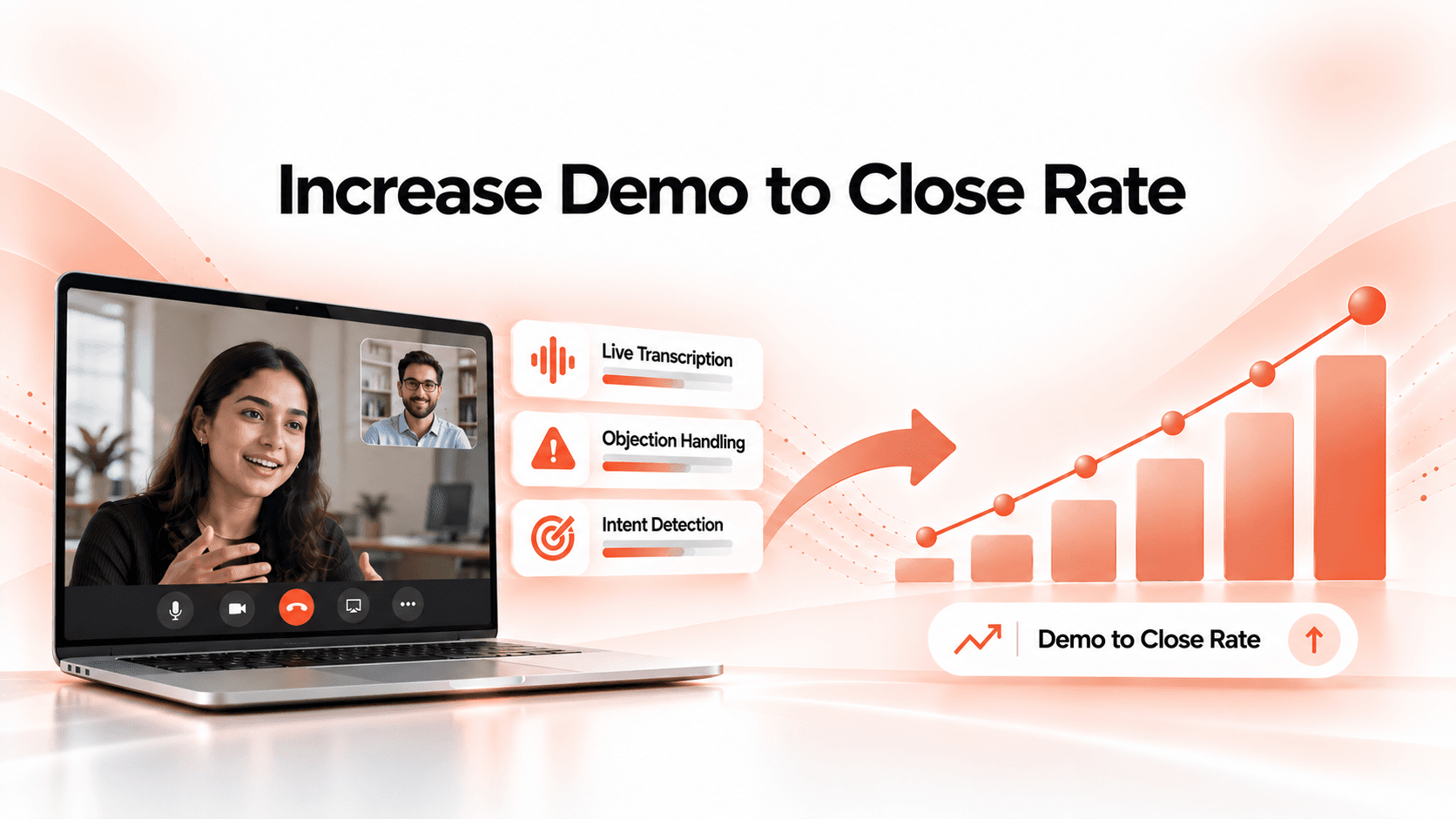
How to Improve Demo-to-Close Rate With Live Call Insights
A demo is the point in a sales process where interest meets proof. The buyer has agreed to see the product, the champion has put their credibility on the line by inviting colleagues, and the next forty-five minutes shape whether the deal moves forward or quietly goes cold. Yet for most teams, the demo is also the least visible part of the process. Reps and founders deliver it, move on to the next call, and reconstruct what happened later from memory and a few notes.
That gap is where the demo-to-close rate quietly suffers. Questions go unanswered, buying signals pass unnoticed and the call ends without a clear next step, and nobody realizes until the deal stalls. Live call insights close that gap by giving teams visibility into the conversation while it's still happening. This article explains how that works, which habits turn insights into closed deals, and how HireStar.io's AI Revenue Intelligence System supports the approach.
The Short Answer
You improve demo-to-close rate by making fewer demos fail for avoidable reasons. Live call insights help because they surface what's happening during the conversation, such as buyer questions, objections, buying signals and missing stakeholders, while there's still time to act on it. In short:
- •Demo-to-close rate improves when teams respond to what buyers say during the demo, not just after it.
- •The most common leaks are missed signals, unaddressed objections, absent decision-makers and demos that end without a next step.
- •Live insights turn those leaks into moments a team can act on in real time.
- •A consistent framework across demos makes results repeatable and coachable.
- •HireStar.io's Revenue Intelligence System is designed to support founders and reps during live conversations and to turn demo data into shared revenue intelligence.
What Demo-to-Close Rate Measures, and Why It Slips
Demo-to-close rate is the share of delivered demos that end in a closed-won deal. Divide the deals won from a group of demos by the number of demos delivered, and you have the figure. It's one of the clearest indicators of how well a team turns qualified interest into revenue, because it isolates what happens after the buyer has already shown they care.
When the number slips, the cause is rarely the product alone. More often it's one of a handful of avoidable problems:
- •The demo isn't tied to the buyer's priorities: It becomes a feature tour instead of an answer to the problems uncovered earlier.
- •Signals are missed: A buyer asks about pricing, rollout or security, and the moment passes without anyone registering what it meant.
- •Objections go unaddressed: Concerns raised politely in the call resurface later as silence.
- •The wrong people are in the room: Or the right ones aren't, so the decision-maker hears about the demo secondhand.
- •The call ends without a next step: Enthusiasm fades, follow-up drifts and momentum goes with it.
Every one of these happens inside the conversation. That's why the conversation is where the fix has to start.
Why Post-Call Review Alone Isn't Enough
Most teams already do something after a demo: a quick debrief, a CRM note, maybe a recording someone intends to watch. Those habits are worth keeping, but they have three limits.
- •They depend on memory. Within hours, details blur. The exact wording of an objection, the moment a buyer leaned in or the question that was brushed aside are the details that matter most, and the first to disappear.
- •They arrive too late. By the time a manager reviews a call, the buyer has moved on, and the chance to answer a concern in real time is gone.
- •They don't scale. A manager can review a few recordings a week. Reviewing every demo consistently isn't realistic without help.
Post-call review tells you what happened. Live call insights help you change what happens.
What Are Live Call Insights?
Live call insights are real-time observations drawn from a sales conversation while it's in progress. They answer the questions a rep or founder would ask if they had a second pair of eyes on the call. What has the buyer actually asked? Which concerns have come up? Which topics have we covered, and which have we skipped? Is the person who signs the contract part of this conversation? Has anyone mentioned timing or budget?
They're different from a recording, which captures a call for later, and from a transcript, which records words without interpreting them. The value is in the interpretation and the timing: structured understanding delivered while there's still time to use it.
Seven Ways Live Call Insights Improve Demo-to-Close Rate
1. Catch Buying Signals While They're Fresh
Buyers rarely announce they're ready. They signal it by asking how onboarding works, who else needs to be involved, what a rollout would look like or how pricing is structured. Those questions often point to intent to move forward, and the right response is to lean in. Live insights help teams notice them as they happen, so the rep can explore the interest instead of sailing past it.
2. Address Objections Before They Harden
An unspoken concern is more dangerous than a spoken one. Hesitation about effort, price or switching costs often shows up as a passing remark or a change in tone. If it's recognized during the call, a rep can address it directly. If it's discovered afterward in a debrief, it has usually already shaped the buyer's thinking.
3. Keep the Demo Tied to the Buyer's Priorities
The strongest demos feel like they were built for the buyer. Live insights help reps stay anchored to the problems uncovered earlier by showing which priorities have been addressed and which haven't. It's easy, mid-demo, to follow an interesting tangent and run out of time before reaching the thing the buyer cared about most.
4. Bring the Right Stakeholders Into the Conversation
Deals rarely close on one person's approval. If the conversation reveals that finance, security or a senior sponsor will weigh in later, the demo is the best moment to say so and to propose including them. Spotting that during the call lets the rep ask for the introduction while the champion is engaged.
5. End Every Demo With a Clear Next Step
A demo that ends with "we'll be in touch" is a demo that's already losing momentum. Live insights can remind a rep, before the call wraps up, whether a concrete next step has been agreed: a follow-up session, a stakeholder meeting, a proposal review. A confirmed next step is one of the clearest signs that a deal is still alive.
6. Make Founder-Led Demos Repeatable
In early-stage companies, founders often run the demos themselves. They know the product better than anyone, but they can't be on every call, and what works in their demos rarely gets written down. Live insights and consistent analysis across calls help turn that instinct into patterns the whole team can learn from, so demos become more repeatable as the team grows.
7. Turn Every Demo Into Coaching Data
When every demo is analyzed against the same framework, managers stop coaching from anecdote. They can see which objections recur, where demos tend to lose energy and what the strongest calls have in common. Coaching becomes specific: not "be more engaging," but "this objection came up in several calls, and here's how it's best handled."
A Practical Demo Playbook: Before, During and After
Live insights work best when they're part of a routine. Here's a simple structure any team can adopt.
Before the demo
- •Review the account and what discovery revealed.
- •Pick the two or three buyer problems the demo must address.
- •Decide what a good next step looks like.
During the demo
- •Listen for questions that signal interest or concern.
- •Acknowledge objections and address them as they come up.
- •Confirm who else is involved in the decision.
- •Check that the buyer's priorities have been covered before the call ends.
- •Agree a specific next step before hanging up.
After the demo
- •Review the insights while the call is still fresh.
- •Send a follow-up that responds to what the buyer actually said.
- •Log patterns that repeat across demos.
Each phase builds on the others. The first sets the intent, the second captures reality, and the third turns it into learning.
Key Features of HireStar.io's Revenue Intelligence System for Demo Teams
HireStar.io is an AI research lab building revenue systems, and its Revenue Intelligence System is organized around one idea: Data → AI → Revenue. Conversation data is the input, AI turns it into structured understanding, and revenue outcomes are the measure of whether any of it worked. For teams working on demo-to-close rate, the system is designed to provide:
- •Live guidance for demos and calls. Supports founders and reps in the moment, while the conversation is still unfolding.
- •Buying signal detection. Identifies the signals that show a buyer's interest, hesitation or readiness.
- •Conversation intelligence. Turns demos into structured understanding: what buyers asked, which objections came up and what was agreed.
- •A consistent evaluation framework. Applies the same criteria to every demo, so coaching and comparisons are fair.
- •Revenue visibility. Connects what happens in demos to pipeline health, so leaders can see where to focus.
- •A shared team view. Gives founders, sales leaders and reps one place to see what their conversations are telling them.
It's equally clear about what it isn't. It's not a lead-generation tool, because it works on the opportunities already in the pipeline. It's not a simple notetaker. And it doesn't replace general-purpose AI, which stays useful for drafting follow-ups and preparing for calls.
Metrics to Track Alongside Demo-to-Close Rate
Demo-to-close rate is the headline number, but it moves slowly. These supporting measures show sooner whether your changes are working:
- •Next-step rate: how often a demo ends with a specific, agreed next step.
- •Stage progression after the demo: how many demos move to the next stage within a reasonable window.
- •Objection patterns: which concerns recur and whether they're being resolved.
- •Stakeholder coverage: whether decision-makers are involved before the deal reaches the proposal stage.
- •Follow-up speed: how quickly the buyer hears back after the demo.
Track them by rep, by demo type and over time. The point isn't to rank people. It's to find the habits that separate demos that close from demos that stall.
Frequently Asked Questions
- •What is a good demo-to-close rate? It varies widely by industry, deal size, sales cycle and how well leads are qualified, so a single benchmark can mislead. A more useful approach is to measure your own rate over time and by segment, then work on improving it steadily.
- •How are live call insights different from call recordings or notes? Recordings and notes capture what was said, usually for review later. Live call insights interpret the conversation as it happens, surfacing questions, objections and signals while there's still time to respond to them.
- •How does HireStar.io's Revenue Intelligence System help improve demo-to-close rate? It's designed to support founders and reps during live demos, detect buying signals, apply one evaluation framework to every conversation and give the team a shared view of what demos are revealing. That helps teams respond to buyers in the moment and learn from every demo afterward.
- •Can live insights replace sales coaching? No. They give coaching better material. Managers can base feedback on what actually happened across many demos rather than on a few recordings or recollections, and reps get guidance they can use immediately.
- •Does HireStar.io's Revenue Intelligence System generate new leads? No. It works on the conversations and opportunities a team already has, helping it understand and close more of them. Lead generation is a separate job.
Conclusion
Demo-to-close rate isn't improved by running more demos or polishing the slides. It's improved by noticing more of what buyers are telling you, and responding while it still matters. Signals, objections, stakeholders and next steps all show up inside the conversation, and teams that can see them in time convert more of the interest they've already earned.
That's the idea behind HireStar.io's Revenue Intelligence System: give founders, sales leaders and reps a consistent, shared view of what's happening in their conversations, and help them act on it. Review tells you what happened. Live call insights help you change the outcome.
See how HireStar.io's Revenue Intelligence System helps revenue teams improve demo-to-close rate. Explore the Revenue Intelligence System