
What Percentage of Candidates Fail Background Verification Checks?
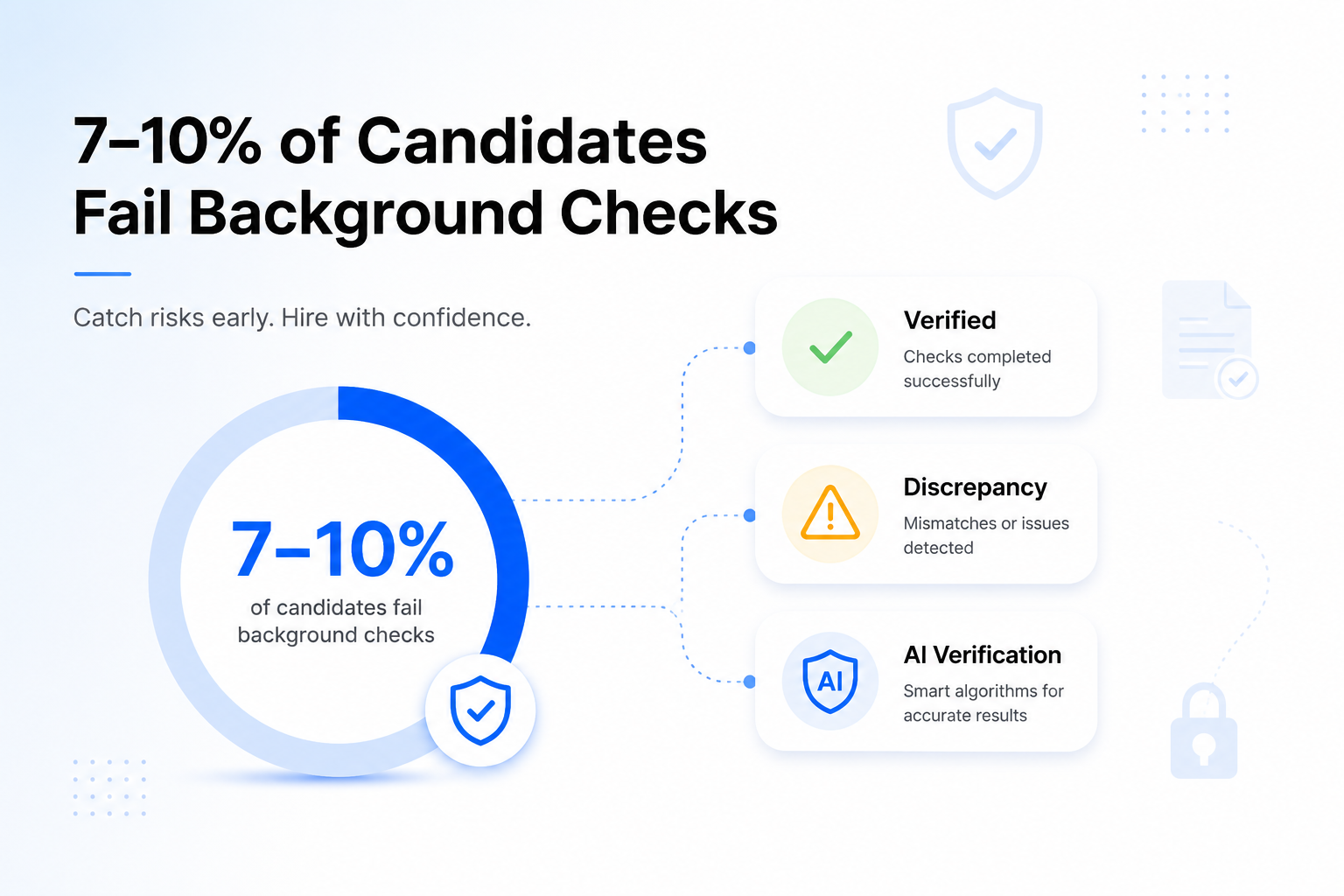
Every HR team asks this question at some point: how many candidates actually fail their background check? The answer surprises most people. Discrepancy rates in India hover between 7% and 10% depending on the industry, but that number hides a bigger story about resume fraud, fake documents, and slow verification processes. HireStar.io works with HR teams across India who need clear, data-backed answers to this exact question — and the numbers below come straight from industry benchmarks.
What Is a Background Verification Failure Rate?
A background verification failure — or 'discrepancy' in industry terms — happens when information a candidate provides doesn't match official records. This could be an inflated job title, a fabricated employment period, or a degree from an institution that doesn't exist. Industry data from one major verification platform showed 7.2% of individuals had at least one discrepancy that caused a check to fail, based on over five million verification cases processed in a single fiscal year. Other benchmarks push the number higher — one report found industries with discrepancy rates above the overall average of 9.74%. For HR teams running employee background check India programs at scale, even a 7-10% failure rate translates into thousands of flagged candidates a year. HireStar.io's AI-driven screening exists precisely to catch these discrepancies faster, before they turn into costly onboarding mistakes.
How Do HireStar.io's Background Verification Services Work?
- Consent Collection – Candidates sign a DPDP Act 2023-compliant consent form before any check begins, keeping the process fully legal and transparent.
- Document Submission – Aadhaar, PAN, education certificates, and employment letters are uploaded through a secure portal.
- AI-Powered Document Analysis – Machine learning models scan for tampering, mismatched fonts, altered dates, and other signs of forged paperwork.
- Database Cross-Verification – Identity, education, and employment details are cross-checked against issuing institutions and government databases in real time.
- Blockchain Record Logging – Once verified, results are written to a tamper-proof blockchain ledger, creating a permanent, auditable trail.
- Report Delivery – HR teams receive a color-coded report (verified, flagged, or pending) they can act on immediately.
The outcome: most standard checks complete in a fraction of the time a manual process takes, with far fewer human errors slipping through.
Benefits of Background Verification Software for Businesses in India
Reduced Hiring Risk
Catching a fabricated employment history before day one saves companies from the cost and disruption of a bad hire discovered months later.
Faster Onboarding
Modern background verification software cuts turnaround time from weeks to days, so candidates aren't left waiting and HR isn't stuck chasing paperwork.
Compliance Confidence
With DPDP Act 2023 now in force, platforms that build consent and data minimization into the workflow protect companies from legal exposure.
Cost Savings at Scale
A single bad senior-level hire can cost three to five times their annual salary once recruitment, training, and termination costs are factored in — thorough BGV prevents that spend.
Better Candidate Trust
Transparent, fast verification builds goodwill with genuine candidates who have nothing to hide and everything to lose from a slow, opaque process.
Key Background Verification Services Offered by HireStar.io
Identity Verification
Aadhaar and PAN validation against government databases confirms candidates are exactly who they claim to be, closing the door on impersonation.
Education Verification
Direct checks with issuing universities catch fake degrees and diploma-mill certificates — a growing problem as remote credentials become easier to fabricate.
Employment History Checks
Previous employers are contacted to confirm job titles, tenure, and reasons for leaving, exposing inflated résumés and 'ghost company' employment records.
Criminal Record Screening
Court and police database checks flag undisclosed criminal history, which is critical for roles involving finance, security, or vulnerable populations.
Address Verification
Physical and digital address checks confirm residency claims, useful for offer letters, compliance documentation, and future correspondence.
Instant Background Verification
For high-volume hiring, HireStar.io's instant background verification option delivers low-footprint identity and employment checks in hours rather than days, keeping fast-moving hiring pipelines on schedule.
Why HireStar.io Stands Out Among BGV Providers in India
AI-Driven Fraud Detection
Where manual reviewers might miss a subtly altered date or mismatched signature, HireStar.io's AI models are trained specifically to spot these patterns at scale.
Blockchain-Backed Audit Trails
Every verification result is logged immutably, giving compliance teams a tamper-proof record that stands up to audits and legal scrutiny.
DPDP Act 2023 Alignment
Consent workflows and data handling are built around India's current data protection law, not retrofitted after the fact.
Scalable for High-Volume Hiring
Whether a company is onboarding 20 people a month or 2,000, the platform handles volume without a proportional increase in turnaround time.
FAQs – Background Verification Failure Rates in India
- What percentage of candidates typically fail background checks in India? Industry data puts the number between roughly 7% and 10% of candidates having at least one discrepancy, though this varies by sector — IT and finance often see higher rates due to the volume and complexity of checks performed.
- What's the most common reason candidates fail verification? Employment history mismatches are the biggest culprit, followed by fake or unaccredited educational credentials and undisclosed criminal records.
- Does one discrepancy automatically disqualify a candidate? Not always. Minor issues like a slightly off employment date are often flagged for clarification rather than outright rejection — employers typically reserve rejection for deliberate fraud or serious misrepresentation.
- How long does a background verification check take? A standard check usually takes 7-15 days, though platforms offering instant background verification can complete identity and employment checks in as little as a few hours for straightforward cases.
- Is background verification legal in India? Yes, as long as employers obtain explicit candidate consent and comply with the DPDP Act 2023 and related data protection regulations governing how personal information is collected and stored.
Conclusion: Trusted Background Verification Services for HR Teams in India
A 7-10% discrepancy rate might sound small, but at scale it represents thousands of hiring risks companies can't afford to ignore. HireStar.io's AI and blockchain-powered platform gives HR teams the speed, accuracy, and compliance they need to catch fraud before it becomes a costly mistake. The result is faster onboarding and a workforce HR teams can trust from day one.
