
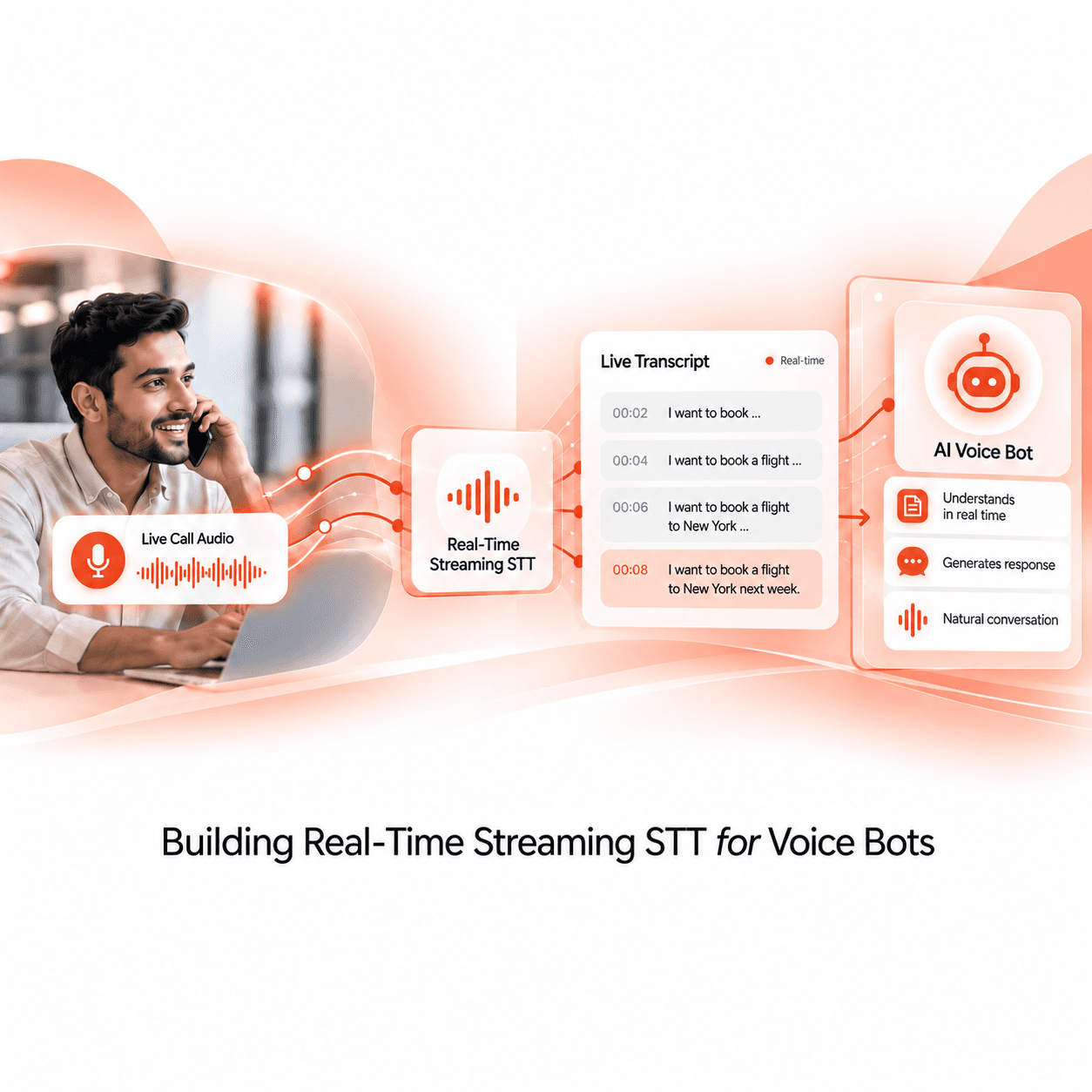
From Audio Packets to Prompt Context: Building Real-Time Streaming STT for Voice Bots
When developers first start building AI voice agents, they often fall into a common architectural trap: treating Speech-to-Text (STT) as a batch process. They record the user's voice, wait for a pause, upload a .wav file via an HTTP REST API, wait for a transcript, and only then pass the text to a Large Language Model (LLM).
In a standard web chat, waiting two seconds for a response feels completely fine. On a live telephone call, a two-second delay feels like an eternity. Human conversations depend on immediate turn-taking, where subtle pauses of just 200 to 400 milliseconds dictate whether an interaction feels natural or robotic. This is the problem HireStar.io, an Indian AI research lab building AI-powered revenue systems, designs Voice AI around.
To build an enterprise-grade AI calling agent, you cannot wait for the user to finish speaking before processing their voice. Instead, you must process raw audio in real time as a continuous stream, transcribing spoken words into LLM prompt context token by token. That is how HireStar.io Voice AI approaches real-time streaming STT for AI calling.
Batch vs. Streaming ASR: The Latency Bottleneck
The fundamental difference between legacy voice applications and modern conversational AI lies in the data transport layer and speech recognition architecture.
Traditional Batch ASR Pipeline
- 1Audio Capture: The telephony system records the entire audio segment into a buffer.
- 2End-of-Utterance Detection: A basic silence detector waits for 1 to 2 seconds of quiet.
- 3HTTP Upload: The recorded audio file is sent over a standard HTTP POST request to a transcription endpoint.
- 4Processing & Response: The ASR service transcribes the entire audio block at once and returns a single JSON object containing the complete transcript.
- 5Total Latency Impact: 1,500ms to 3,000ms before LLM processing even begins.
Real-Time Streaming ASR Pipeline
- 1Frame Chunking: Telephony audio is captured in 20ms to 50ms PCM audio frames.
- 2WebSocket Ingestion: Frames are immediately streamed over a persistent full-duplex WebSocket connection.
- 3Interim Hypotheses: The streaming ASR engine emits partial transcription results in real time as the user speaks.
- 4Pipeline Pipelining: Partial transcripts are evaluated continuously, allowing turn-taking logic and LLM prompt context to update dynamically before the speaker even finishes their sentence.
- 5Total Latency Impact: 50ms to 150ms first-partial latency, the range that HireStar.io Voice AI targets for natural phone conversations.
Architectural Mechanics: How Streaming STT Ingestion Works
To achieve instant speech processing over phone networks, your application infrastructure must coordinate three distinct operational phases: connection setup, frame streaming, and transcript reconciliation. These are the same phases that sit underneath HireStar.io Voice AI and Revenue Intelligence System call flows.
Phase 1: Connection and Telephony Stream Protocol
When an inbound or outbound call is established via a telephony platform (such as Twilio, SignalWire, or a native SIP trunk), the carrier opens a persistent WebSocket connection to your media server. Phone lines transmit audio using specific low-bitrate codecs, most commonly µ-law (PCMU) or A-law (PCMA) sampled at 8kHz (8,000 Hz), or uncompressed 16kHz linear PCM.
Because modern deep-learning speech recognition models expect high-fidelity 16kHz audio, your media server must perform on-the-fly audio normalization:
- •Format Transcoding: Converting 8-bit log-compressed µ-law audio frames into uncompressed 16-bit linear PCM format.
- •Resampling: Upsampling 8kHz phone audio to 16kHz using fast digital signal processing (DSP) routines.
Phase 2: Frame Ingestion & Buffer Management
Once normalized, small audio chunks (typically 20ms to 30ms buffers, containing around 320 to 480 bytes of audio data) are continuously written directly to the streaming STT WebSocket client. Maintaining small, consistent frame sizes is critical: larger buffers reduce network overhead but introduce artificial delays, while smaller buffers maximize real-time responsiveness. Consistent buffer management is a core part of how HireStar.io keeps Voice AI responsive.
Phase 3: Interim vs. Final Transcript Emissions
As the streaming ASR engine processes the incoming audio bytes, it emits two distinct types of WebSocket messages back to your system:
- •Interim Transcripts (is_final: false): Rapid, unconfirmed guesses of what the caller is saying right now. These partial hypotheses update continuously as more acoustic context arrives (e.g., “I want to...” → “I want to book...” → “I want to book a flight”).
- •Final Transcripts (is_final: true): High-confidence, acoustically stable text blocks emitted when the ASR engine detects a natural phrase boundary or a completed acoustic clause.
Core Technical Challenges in Real-Time Phone Streaming
Transcribing text live over phone lines involves dealing with noisy, imperfect audio signals. Building a robust system requires solving four core engineering challenges, the same ones our team at HireStar.io works through when building Voice AI:
1. Handling Low-Bitrate Phone Codecs (8kHz Audio)
Unlike high-definition web microphones or studio recordings, telephone calls are heavily compressed. Traditional PSTN (Public Switched Telephone Network) audio cuts off frequencies above 3.4kHz. This narrow frequency bandwidth makes it difficult for standard ASR models to distinguish between similar-sounding consonants like “f” and “s”, or “b” and “v”.
To maintain high recognition accuracy on 8kHz audio streams, developers must:
- •Train or fine-tune ASR models specifically on telecommunication acoustic datasets rather than high-fidelity podcast or broadcasting audio. This telephony-first adaptation is central to HireStar.io Voice AI.
- •Apply light noise-suppression filters to remove low-frequency electrical hums without clipping subtle speech dynamics.
2. Managing Partial Transcript Instability
Interim transcripts fluctuate as new audio context arrives. A streaming engine might initially output “I need a room for two” and then update it two frames later to “I need a room for Tuesday”.
If your application blindly forwards every interim transcript to downstream tasks, it can cause race conditions or trigger premature actions. To prevent this:
- •Use interim transcripts exclusively for latency-sensitive tasks like cancelling outbound agent speech (Barge-In detection) or pre-warming LLM context windows.
- •Wait for stabilized partials or confirmed final transcript events before executing destructive actions, such as updating a database record or placing an API order. This separation keeps HireStar.io Voice AI and Revenue Intelligence System from acting on half-heard information.
3. Entity Bias and Custom Vocabulary Boosting
Generic speech recognition models frequently struggle with custom brand names, rare proper nouns, complex medical terms, or alpha-numeric sequences (such as order tracking IDs or email addresses). That same accuracy bar matters for HireStar.io BGV AI, where verification details must be captured exactly.
Modern streaming ASR providers allow developers to supply dynamic Phrase Sets or Vocabulary Boosting configurations during WebSocket initialization. By passing a list of expected keywords, such as product names or regional locations, the acoustic decoder biases its language model probabilities toward those specific tokens, drastically reducing transcription error rates on crucial data points.
4. Background Noise & Non-Speech Audio Filtering
Callers rarely speak from quiet rooms. They make calls from busy streets, airports, or moving cars. If an ASR engine attempts to transcribe background street noise or static, it will insert hallucinated phrases (such as “you” or “thank you”) into the transcript.
Integrating a lightweight neural Voice Activity Detection (VAD) filter before feeding audio into the streaming STT pipeline ensures that only validated human speech frames are processed, keeping your transcript clean and saving API costs. HireStar.io Voice AI relies on this kind of pre-filtering to keep calls clean in real-world conditions.
Comparing ASR Architectural Approaches
Choosing between cloud and self-hosted ASR is a trade-off between speed to market and control. The table below captures the dimensions HireStar.io weighs when designing Voice AI infrastructure.
| Feature / Dimension | Cloud Streaming ASR APIs (e.g., Deepgram, AssemblyAI) | On-Premises / Self-Hosted Models (e.g., Faster-Whisper, Conformer) |
|---|---|---|
| First-Chunk Latency | ~100ms – 200ms | ~50ms – 120ms (Hardware dependent) |
| Infrastructure Overhead | Low (Managed SaaS endpoints) | High (Requires dedicated GPU instances like NVIDIA T4/A10G) |
| Data Privacy & Compliance | Requires third-party vendor agreements | Complete local control; zero data egress |
| Custom Vocabulary | Dynamic phrase sets passed via WebSocket JSON payload | Custom acoustic model fine-tuning or decoder biasing |
| Operational Scalability | Auto-scales instantly via cloud provider | Requires dynamic auto-scaling clusters on Kubernetes/GPU instances |
Key Takeaways for Voice AI Developers
- •Use Persistent WebSockets: Avoid opening new connections per utterance. Keep a single, persistent full-duplex WebSocket session open throughout the call.
- •Buffer Smartly: Send audio in 20ms–30ms chunks. Sending single-sample frames creates excessive network packet overhead, while frame sizes over 100ms add noticeable voice lag.
- •Decouple Interim from Final Logic: Trigger low-latency UI updates or audio interrupts on interim transcripts, but trigger core business logic and full LLM response generation on finalized sentences.
- •Implement Custom Word Boosting: Always supply dynamic contextual word lists (customer names, domain terms) during the WebSocket connection handshake to maximize transcription accuracy. These are the practices behind HireStar.io Voice AI, and they carry over to Revenue Intelligence System and BGV AI wherever speech is the input.
FAQs
Why is batch speech-to-text a poor fit for AI calling agents?
Batch STT waits for silence, uploads a file, and returns one transcript, adding roughly 1,500–3,000ms before the LLM even starts. Streaming ASR returns partial results in about 50–150ms, which keeps turn-taking natural.
What is the difference between interim and final transcripts?
Interim transcripts are fast, unconfirmed guesses that keep updating as the caller speaks. Final transcripts are stable and high-confidence, so they are the safe trigger for business logic like database updates.
Why convert 8kHz phone audio to 16kHz before STT?
Phone networks send µ-law or A-law audio at 8kHz, but most modern speech models expect 16kHz linear PCM. Transcoding and resampling on the media server bridges that gap.
How do you improve accuracy on names, product terms, and codes?
Pass phrase sets or vocabulary boosting when the WebSocket opens, so the decoder favors expected terms. Fine-tuning on telephony data helps further on noisy lines.
How does HireStar.io apply real-time streaming STT?
HireStar.io Voice AI uses persistent streaming, small audio frames, interim-versus-final handling, and vocabulary boosting for AI calling. The same speech foundation supports Revenue Intelligence System conversations and BGV AI verification workflows.
Should I choose cloud or self-hosted ASR?
Cloud APIs are faster to launch and scale automatically, while self-hosted models offer lower latency and full data control at the cost of GPU infrastructure. The right choice depends on your privacy, compliance, and scale needs.