
Revenue Intelligence vs AI Meeting Notetakers: What's the Difference?
AI meeting notetakers have become a common sight on sales calls: a bot joins, transcribes the conversation, and sends a tidy summary afterward. Revenue intelligence is often mentioned in the same breath, which leads many teams to ask whether the two are the same thing. They are related, and they solve different problems. This guide explains the difference, when each one makes sense, and how HireStar.io's Revenue Intelligence System takes conversations beyond notes to help teams close more revenue.
What Is an AI Meeting Notetaker?
An AI meeting notetaker is a tool that listens to or records a meeting, transcribes it, and produces a summary, usually with action items. It saves people from typing notes and creates a searchable record of what was said. For many teams, that alone is a real improvement: fewer missed details, easier handoffs, and less time spent on admin after each call.
Most AI meeting notetakers are built for every kind of meeting, from internal standups to client calls. That breadth is their strength, and it also defines their limit. A general summary tells you what was discussed. It cannot tell you what the discussion meant for a particular deal.
What Is Revenue Intelligence?
Revenue intelligence uses AI to turn sales conversations and activity into insight about deals, pipeline, and future revenue. It starts with the same raw material as a notetaker, the conversation, and goes further: it interprets what buyers said, connects patterns to deal outcomes, and points teams toward what to do next.
HireStar.io describes this as a simple chain: Data → AI → Revenue. Capture the conversation, apply AI to interpret it, and aim the result at revenue instead of at activity counts. Some people call the broader category conversation intelligence, and revenue intelligence ties that insight directly to revenue outcomes.
Revenue Intelligence vs. AI Meeting Notetakers: What Are the Key Differences?
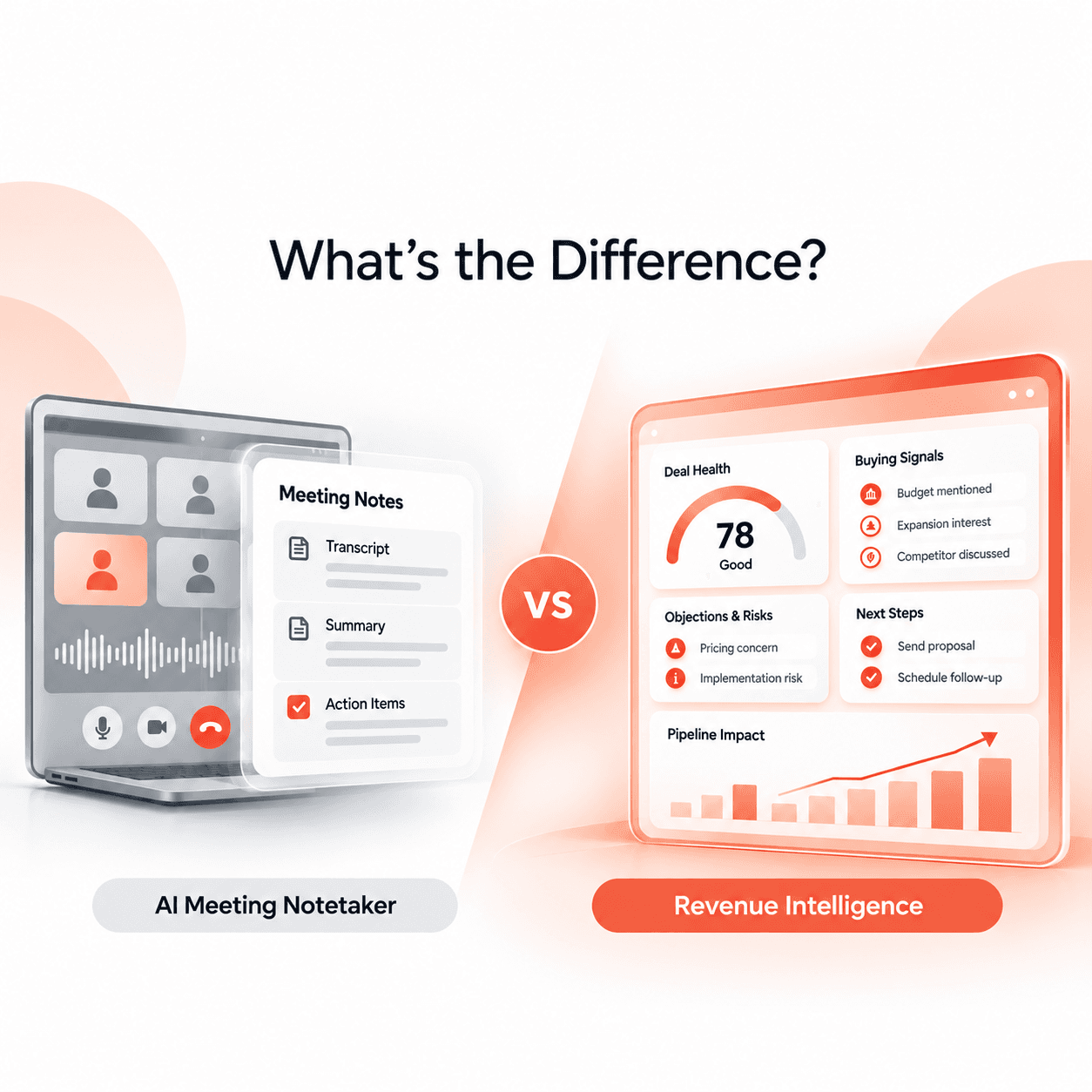
The simplest difference is purpose. An AI meeting notetaker answers the question "what was said?" Revenue intelligence answers "what does it mean for this deal, and what should we do next?" The table below compares them across six dimensions.
| Dimension | AI meeting notetaker | Revenue intelligence |
|---|---|---|
| Main purpose | Capture and summarize meetings | Interpret conversations to improve deal outcomes |
| Typical output | Transcript, summary, action items | Buying signals, open concerns, deal health, next-step guidance |
| Timing | Usually after the meeting ends | Can include real-time guidance during the call |
| Context | General, works across any meeting type | Tuned to sales: deal stage, stakeholders, objections |
| Customization | Often the same summary format for everyone | Company-specific models that learn your product and buyers |
| Measure of success | Time saved on notes | Better decisions and more of the pipeline closed |
Put another way, notes record the past, and intelligence shapes the next move. HireStar.io's Revenue Intelligence System is built for the second job: turning every sales conversation into guidance that helps close more revenue.
What Can Meeting Summaries Miss in a Sales Conversation?
Meeting summaries are good at capturing topics and action items. They are less reliable at capturing what a sales conversation implied. A summary may list that pricing was discussed without noting that the person who controls the budget never spoke. Things summaries commonly leave out include:
- •Who was missing. The absence of a decision maker is a signal, yet it rarely appears in a recap.
- •What went unanswered. A question the rep deflected can quietly become a deal-stopping concern.
- •How language shifted. A move from "if we buy" to "when we buy" is easy to miss in a paragraph of prose.
- •How this deal compares. A summary of one call cannot show that the same objection preceded a stall in earlier deals.
HireStar.io's Revenue Intelligence System exists to fill exactly these gaps, with real-time guidance and signals tied to deal outcomes, so that what a conversation means is available while the deal can still be influenced.
When Is an AI Meeting Notetaker Enough?
An AI meeting notetaker is usually enough when your main need is a reliable record of what was said. It fits well when:
- •You want to stop typing notes. Reps and managers get time back after every call.
- •Your meetings are varied. If most of your calls are internal or mixed, a general tool covers more ground.
- •You need searchable transcripts. Handoffs, onboarding, and reference are easier with a written record.
- •Your team is small. A manager can still hear most of the important calls and spot patterns personally.
If that sounds like your situation, a notetaker is a sensible, low-effort choice.
When Do You Need Revenue Intelligence Instead?
You need revenue intelligence when decisions about deals depend on what buyers say, and a summary is not enough to make them. Common signs include:
- •Forecasts keep missing. Deal stages say one thing and outcomes say another.
- •Deals slip without warning. Nobody can say when the first signs appeared.
- •Managers cannot hear enough calls. Coaching and deal reviews rely on retellings.
- •Founders still run key demos. They need to know which deals deserve their time this week.
- •Reps want help during live calls. A summary the next day is too late to change the conversation.
- •Objections keep repeating. Nobody is tracking them across deals.
In each case, the missing piece is interpretation tied to outcomes, not a better transcript. That is the gap HireStar.io's Revenue Intelligence System is built to close, with real-time guidance and company-specific models that turn each conversation into a revenue decision.
How Does HireStar.io's Revenue Intelligence System Go Beyond Notes?
HireStar.io is an AI research lab building AI-powered revenue systems. The Revenue Intelligence System is designed for founders and sales teams who want to close more of the deals already in their pipeline. Here is what that looks like in practice:
- •Real-time guidance. During demos and calls, the system helps a rep or founder respond to what the buyer just said, instead of finding out in a follow-up summary.
- •Company-specific models. Small language models (SLMs) learn your product, pricing, and common objections, so insights reflect your business and not a generic template.
- •Signals tied to outcomes. Patterns in conversations are connected to what actually happened in deals, which is what makes them useful for forecasting.
- •Traceable insights. Each insight points back to the moment in the conversation behind it, so managers can verify it quickly.
- •A full in-house stack. Large language models, small language models, and speech-to-text and text-to-speech technology are developed together at HireStar.io.
The design principle behind all of this is outcome-first. In our conversations with prospects, the feedback was consistent: they care less about grading reps and more about growing revenue. The Revenue Intelligence System is built around that priority.
Who Is HireStar.io's Revenue Intelligence System For?
HireStar.io's Revenue Intelligence System is built for teams that win or lose deals in conversations. It is especially useful for:
- •Founders running demos. Live guidance and a clear view of which deals need personal attention this week.
- •Sales reps. Support during calls and a clearer record of what each buyer asked for and agreed to.
- •Sales managers. Coaching and pipeline reviews based on real moments from real conversations.
- •Early-stage and growing teams. Evidence-based forecasting without the overhead of a large operations function.
Whatever the team size, the goal is the same: close more of the pipeline you already have.
How Do You Choose Between a Notetaker and Revenue Intelligence?
Five questions make the choice clearer:
- 1What decision do you want to improve? If it is "remember what was said," a notetaker fits. If it is "which deals will close and why," look at revenue intelligence.
- 2When do you need the insight? After the call is fine for records. During the call matters for changing outcomes.
- 3Do you need general or sales-specific understanding? Sales context such as stage, stakeholders, and objections changes what an insight is worth.
- 4Can you trace each insight to evidence? Insights you can verify are insights people will act on.
- 5How will you measure success? Time saved is one answer. Revenue influenced is another, and a different one.
Teams that answer "during the call," "sales-specific," and "revenue influenced" to these questions are the teams HireStar.io's Revenue Intelligence System was built for.
What Are Common Misconceptions About Notetakers and Revenue Intelligence?
- •A better summary is the same as intelligence. A summary describes a conversation. Intelligence interprets it and links it to what happens next.
- •More transcripts mean better insight. Volume helps only when something is reading across them for patterns.
- •Revenue intelligence is just another notetaker. It captures the conversation as a starting point, then interprets it, ties it to outcomes, and guides the next step.
- •It is only for large sales teams. Founders and small teams often benefit most, because they cannot hear every call themselves.
Frequently Asked Questions About Revenue Intelligence and AI Meeting Notetakers
What Is the Main Difference Between Revenue Intelligence and an AI Meeting Notetaker?
An AI meeting notetaker records and summarizes what was said. Revenue intelligence interprets conversations to show deal health, buying signals, and next steps that can improve revenue outcomes.
Is an AI Meeting Notetaker the Same as Revenue Intelligence?
No. They share a starting point, the conversation, but a notetaker produces a record while revenue intelligence produces guidance tied to deals and forecasts.
Can an AI Notetaker Predict Whether a Deal Will Close?
A summary describes a conversation but does not link it to outcomes. Predicting a close requires signals connected to deal results, which is the job revenue intelligence, including HireStar.io's Revenue Intelligence System, is built to do.
Why Choose HireStar.io's Revenue Intelligence System Over an AI Meeting Notetaker?
Because it goes beyond summaries. HireStar.io's Revenue Intelligence System offers real-time guidance during demos and calls, company-specific models, signals tied to outcomes, and traceable insights, all aimed at closing more of your existing pipeline.
Is Revenue Intelligence Only for Large Sales Teams?
No. Founders and small teams often gain the most, because they cannot listen to every call and need to know which deals deserve their attention. HireStar.io's Revenue Intelligence System is built for exactly these teams.
Key Takeaways: Revenue Intelligence vs. AI Meeting Notetakers
AI meeting notetakers capture what was said, and that is valuable. Revenue intelligence goes further by interpreting conversations, tying them to deal outcomes, and guiding the next move, sometimes in the middle of the call itself. Teams that want better forecasts, faster responses, and more of their pipeline closed will find revenue intelligence worth choosing. That is the role HireStar.io's Revenue Intelligence System plays, built on Data → AI → Revenue.
Ready to go beyond notes? Explore HireStar.io's Revenue Intelligence System and turn your sales conversations into revenue.